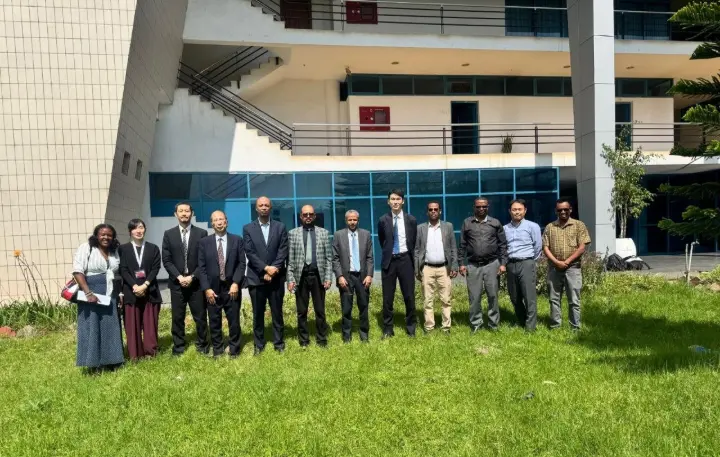
Hawassa University's President Dr. Chirotaw Ayele and JICA Project Coordinator, Mr. Nakamura Genya, signed a collaborative project agreement in the presence of delegates from Tottori University in Japan, JICA, and Japan Science and Technology Agency (JST) on the development of a regenerative agricultural system to optimize agricultural profitability and environmental functions, part of the Science and Technology Research Partnership for Sustainable Development (SATREPS) project initiative.
The project will be jointly implemented by Hawassa and Tottori universities, and involves other stakeholders from Japanese universities and various Ethiopian government partners including the federal government and the Sidama Regional State.
The research project integrates four key components: agronomy, agroforestry, animal and range science, and socioeconomics. Dedicated joint research team are assigned for each components with clear institutional and individual responsibilities.

A Collaborative Research Agreement (CRA) was signed between JICA, Hawassa University and Tottori University, while the final agreement between JICA and Hawassa University, which will establish the full framework for project implementation, is expected to be signed early next year.
During the signing ceremony, Dr. Chirotaw Ayele pledged strong commitment and support for the successful implementation of the project.
Dr. Tafesse, V/President for Research & collaboration at HU, also highlighted the project's importance in strengthening international research collaboration and developing practical solutions to improve agricultural productivity, farmers' livelihoods, soil health, and environmental sustainability.
Prof. Nigussie Haregeweyn, Principal Investigator of the project from Tottori University, emphasized the importance of integrating scientific knowledge, local experience, and the Japanese expertise to develop regenerative agricultural systems that improve both agricultural profitability and ecosystem functions.