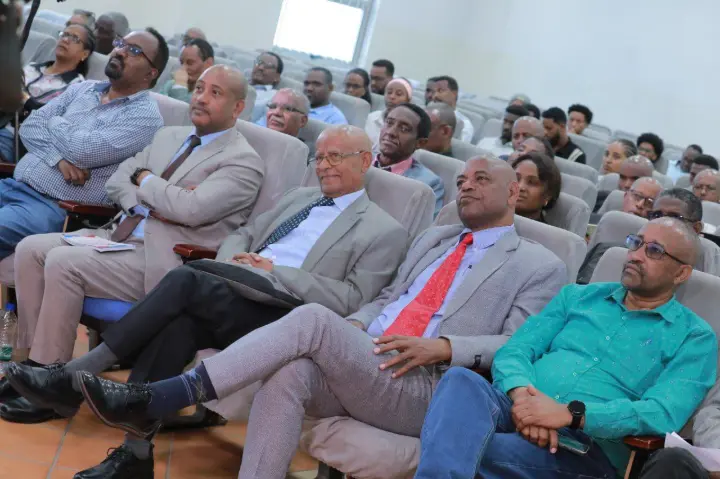
College of Social Sciences and Humanities at Hawassa university has organized a panel discussion entitled, "The quest for considering Amharic as one of the official languages of African Union: Historical foundations, Contemporary realities, and policy implications".
In his opening speech, Prof. Zeleke Arficho, the college Dean, stated that, "Language is far more than a means of communication as it is a storehouse of history, culture, identity, and knowledge." "Hence", he added, "in the context of continental governance and diplomacy, language represents inclusion, recognition, and people's collective voices". Prof. Zeleke explained the objective of the panel as a platform of academic discourse that informs policy makers concerning the recognition of Amharic as one of the official languages of African Union touching upon broader questions of linguistic equity, historical legitimacy, and Africa’s intellectual and cultural sovereignty.
Two panelists, Professor Emiratus Baye Yimam from Addis Ababa University and Dr. Fekede Menuta from Hawassa university, both senior researchers in language and linguistics, presented their views on the legitimacy of the issue considering Ethiopia's vital role in the foundations and continuation of AU and being the center of African politics.
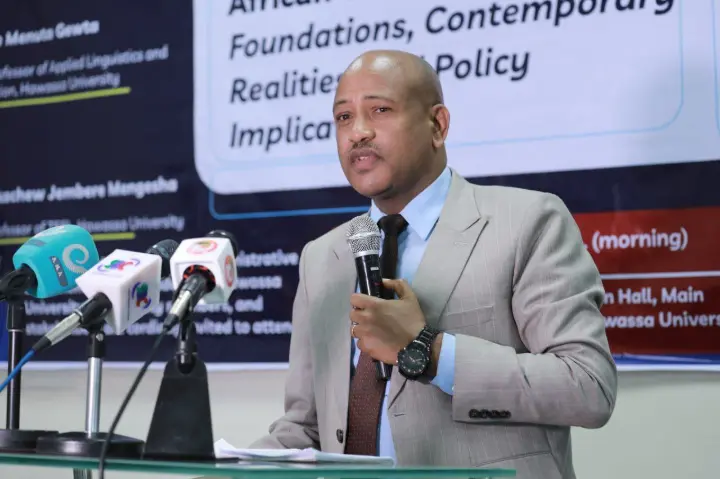
Prof. Baye elaborated on the historical foundations of OAU, Ethiopia's anti-colonial stand and pan African perspective for independence and Emperor Haile Selassie's role as lead organizer of the OAU, Ketema Yifru serving as a main facilitator and Kifle Wodajo's contributions as Secretary-General during the establishment of OAU. He also mentioned Amharic language's unique linguistic characteristics, having well developed orthography and grammar, and how its significance was lost in the dust and mist of revolutions at home.
Dr. Fekede, on the other hand, added the AU MDG ideologies of using "languages for integration and development" which revived the new quest "why not Amharic?".
Both panelists underscored the public and government role in nurturing multilingualism in Ethiopia where languages should be used as means of integration, economic advancement and strong nationalism instead of segregation.
Participants also raised several points in this regard especially on issues of strengthening the language at home before expecting it to be included in continental agenda.