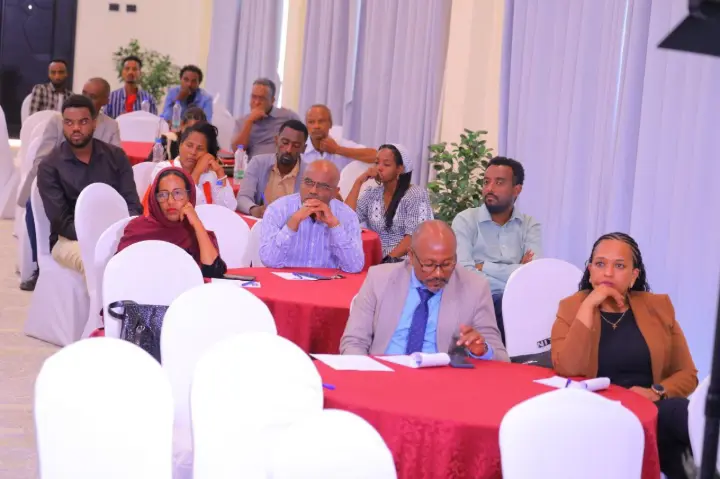
Hawassa University held a launch and stakeholders engagement workshop for a five-year collaborative research project with Johns Hopkins University entitled, Evaluation of Malaria Epidemiology, Resistance and Genomics in Ethiopia (EMERGE).

Speaking at the program, the V/President for Research & Collaboration at HU, Dr. Tafesse Matewos, stated that the College of Medicine & Health Sciences is one of the few leading colleges of its kind in the country, producing competent health professionals and playing a significant national role by conducting numerous problem-solving researches.
Dr. Tafesse also pointed out that the college currently has four centers of research excellence, contributing to the achievement of one of the Sustainable Development Goals—building a healthy and productive society. He emphasized that the Center for Malaria & Other Vector-Borne Diseases Research is carrying out highly important task both nationally and globally.
Furthermore, Dr. Tafesse explained that due to the worsening effects of climate change, malaria is increasingly spreading to areas where it had not previously been prevalent, so he appreciated the Center’s Director, Dr. Dawit Hawaria, and his team for securing a new project that enables coordinated efforts among all stakeholders to address this growing global challenge.

Dr. Chirotaw Ayele, President of Hawassa University, announced that the university has a plan to further strengthen and elevate the Center for the Study of Malaria and Other Vector-Borne Diseases from its current level into a large, nationally recognized center of excellence that serves not only the local community but the entire country. He also stated that the ongoing activities are being monitored at the level of the Ministry of Health signaling its importance in fighting malaria. Furthermore, Dr. Chirotaw noted that the university’s location in the Rift Valley provides a great opportunity for such research endeavors, hence the university aims to enhance its impact by developing enabling infrastructure and engaging a wide range of stakeholders to carry out more effective and impactful work. He sincerely thanked Dr. Dawit Hawaria, Dr. Solomon Kibret and office of VPRC for the establishment of the center and congratulated Dr. Dawit for his dedication.
Dr. Fitsum W/Gebriel, Chief Executive Director of the CMHS at HU, delivered a keynote address where she emphasized that malaria does not only cause sickness but also exposes many citizens to death. She pointed out that those most affected are productive members of society, and that children are among those who lose their lives, so malaria imposes not only a public health burden but also a significant economic strain in a country like Ethiopia. Therefore, Dr. Fitsum stated that the University’s contribution to this highly meaningful research demonstrates its commitment to playing a vital role in the mission of building a healthy and productive society—both nationally and globally.
Fimally, Dr. Dawit Hawaria presented the project’s broad and comprehensive plans for the next five years in undertaking in-depth research on malaria and other vector borne diseases and train the next generation of researchers in this fields of epidemiology, diagnostics and genomic science.
Following the presentation, various stakeholders including the Sidama Regional state Health Bureau and the Institute of public Health participated in a warm discussion.