Farm Africa and SOS Sahel Ethiopia have organized a high-level dissemination and scale up workshop for the Landscape Change Tracking System (LSCTS) developed in collaboration with Wondo Genet College of Forestry and Natural Resources (WGCFNR), Hawassa University, piloted in 16 woredas of Bale Ecoregion and 4 East Bale Adjacent woredas, financed by the Royal Norwegian Embassy.
In his welcoming remarks, Dr. Girma Ayele, Deputy Head of Programs at Farm Africa, noted that the digital system helps to overcome the challenges of physically monitoring forest coverage and changes in the landscape. He expressed a heartfelt gratitude for all partners in the project.
Mr. Bona Yadessa, Head of Oromia State Environmental Protection Authority, expressed deep appreciation for the partners in developing this critical technology as "an entry point in the national forestry sector transformation". He acknowledged the valuable contributions of Farm Africa and its partners in supporting the sustainable forestry and natural resources management policy of the government of Ethiopia over the years and the continued efforts manifested by this project. He also sincerely acknowledged WGCFNR for its pivotal role in advancing knowledge in Forestry and developing the landscape tracking and monitoring system at Bale Ecoregion level. He mentioned the favorable government policies recently inacted in Ethiopia such as the Green legacy, REDD+, land restoration campaign through bilateral and multilateral collaborations, and pledged to scale up the experiences gained from the Bale ecosystem.
Dr. Shimelis Nigatu, Director of Collaborative Projects Coordination at HU, also underscored the great capacity and longstanding experiences of Hawassa University in initiating and executing international collaborative projects.
Dr. Zerihun Asrat from WGCFNR presented a review of Ethiopian forest coverage with the changes observed over the years. He mentioned that the national commitment to natural resources preservation and reafforestation coupled with the multifaceted pressures on the sector require a state-of-the art forest monitoring system for evidence-based decision making and sustainable management.
In addition, Mr. Addisu Bole from WGCFNR presented the process of the landscape change tracking system development and the fact that it has been piloted across twenty woredas in Bale Ecosystem, and ready for scale up.
Dr. Teshale W/Amanuel, Dean of the WGCFNR, spoke about the foundations and developments of the college with its current capacity to deal with emerging global issues and trends in the forestry sector, especially capitalizing on the need for knowledge management, digitalization, global collaboration, and networking for sustainability. He emphasized that need HU, development partners and all stakeholders should work in collaboration to realize the full potentials of the recently launched Forestry Knowledge Management Center (FKMC) at WGCFNR.
The event included a panel discussion on the way forward to disseminate and scale up the project outputs by three senior scholars: Dr. Beyene Teklu (HU, WGCFNR), Mr. Alemayehu Nigussie (Nature and Biodiversity Union, NABU), and Dr. Yigremachew Seyoum (Director of World Resource Institute).
Dr. Gudina Legesse officially closed the session where he noted that, "to ensure the sustainability and scaling up of the piloted LSCTS to regional level, Farm Africa and SOS Sahel Ethiopia sponsored the upcoming capacity building training for experts from Oromia Environmental protection Authority by MRV department at WGCFNR.
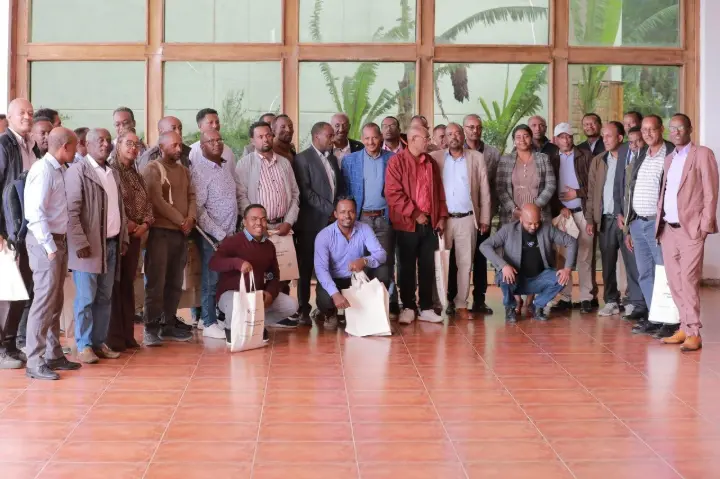
The conference on March 28, 2026 in Bishoftu brought together academics, researchers, development agents and policy makers in the sector.
